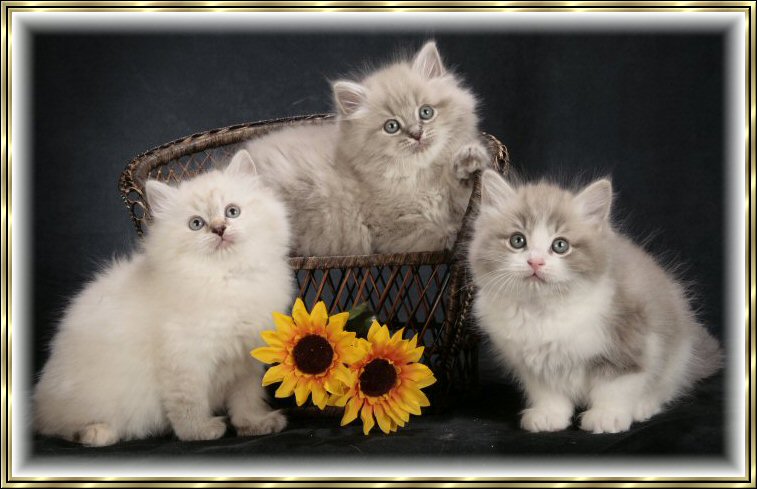
The RagaMuffin is a large, muscular cat with a sweet expression, a silky rabbit-like coat and a temperament that is hard to beat. Every possible colour and pattern is allowed, and the breed is known for being exceptionally people-oriented.
The story of the RagaMuffin
The story of the RagaMuffin begins with an accident. During the 1960s, Ann Baker, a Persian breeder, developed a friendship with a neighbour who fed and cared for a colony of feral cats. A car struck one of these cats, named Josephine, who had previously given birth to wild kittens. After Josephine returned to health, she delivered a litter of kittens that impressed people with their sweetness and sociability. Although any differences in temperament could be explained by natural variation or having different fathers, a highly unscientific theory was that the accident somehow accounted for the kittens’ docile nature, which persists to this day.
Ann gathered as many of Josephine’s kittens as possible and began breeding to preserve the wonderful personality of these cats that went limp as a rag doll when cuddled. She gave the cats the angelic name Cherubim. The most famous of Josephine’s random-bred offspring was Buckwheat, a black shorthair female that resembled a Burmese, and Daddy Warbucks, a male with Birman-like points and mitts. Many of the Cherubims had points and mitts, but others came in a rainbow of solid colours and bicolour variations. Ann called these non-pointed and non-mitted cats Miracle Ragdolls.
Determined to direct the progress of her Cherubim cats, Ann developed strict rules for anyone wishing to breed them. She alone knew the ancestor of each cat and made all breeding decisions. In 1967 a group split away from Ann’s control, taking their cats to the mainstream registries to show and make their own breeding choices. They chose to call their cats Ragdolls and to breed only pointed cats in three patterns. Bitter over the defection, Ann took steps to exert greater control over the development of “her” breed. She set up her own registry, the International Ragdoll Breeders Association (IRCA), and required all her breeders to register only with her. Ann patented the name Ragdoll for use only with cats of her breeding registry. Catteries were franchised and paid royalties for each kitten sold. For more than 20 years Ann’s programme continued, with Cherubim breeders relatively content to enjoy raising kittens while allowing Ann to make marketing and breeding decisions. Eventually her loyal group developed misgivings about Ann, who struggled to keep a healthy cattery while handling the responsibilities of the registry.
By 1993 a group of breeders including Janet Klarmann, Curt Gehm and Kim Clark persuaded Ann to retire and planned to take over management of the association. However, after a few months Ann refused to relinquish control. Regretfully the group voted to leave IRCA and seek recognition with established registries. Since their cats included all colours and patterns, and they signed contracts not to use the Ragdoll name, the first crisis focused on what to call the cats. In the process of submitting a standard to the American Cat Fanciers Association, Janet Klarmann credits Curt Gehm of Liebling cats in Virginia with the choice of RagaMuffin, because they came from little urchin cats of Riverside. The M is capitalised because they are big, huggable, loveable Muffins. The new name stuck, and in May 2001 the cats gained championship recognition.
A breed apart
From the beginning, RagaMuffin breeders have faced the challenge of gaining acceptance for their cats as a distinct breed, despite the common origins with the Ragdolls. The patterns that form such an important part of the Ragdoll standard receive little emphasis from RagaMuffin breeders. They accept every colour and pattern with or without white, but the differences go deeper than that.
The RagaMuffin has a distinct head shape. Rather than having a flat plane between the ears, the skull has a slight dome. The Muffin has a shorter nose than the Ragdoll and walnut rather than oval-shaped eyes. While the Ragdoll profile exhibits a gentle curve with the final segment being straight, the RagaMuffin standard requires an obvious nose dip and scoop. RagaMuffin breeders aim to produce a rounded, more heavily boned cat. The RagaMuffin’s coat is texturally similar to that of a rabbit — shorter and thicker than a Ragdoll’s medium-long silky coat.
Breed highlights
RagaMuffins are large, muscular cats that do not reach full maturity until they are approximately four years old; the females can be substantially smaller than the males. The body is rectangular with a broad chest and powerful shoulders supporting a short neck. The muscular, fit cat often has a fatty pad in the lower abdomen. The head is a broad modified wedge with a rounded forehead and an obvious nose dip. Large walnut-shaped eyes give a sweet appearance. These longhaired cats have a dense, silky coat like that of a heavily furred rabbit, and their fur grows longer around the face and neck (ruff), increasing in length towards the stomach and giving a wispy frill on the hind legs. Every possible colour and pattern is allowed, with little emphasis placed on perfection and markings.
Personality
The only extreme allowed in this breed is its very docile nature. These cats love people and are extremely affectionate and cuddly, with a tendency to go limp or relaxed when held. They will do nearly anything for a tummy rub. While not terribly athletic, they love playing, climbing scratch posts, chasing laser lights and fetching toys. They greet family members and strangers at the door. RagaMuffins remain underfoot and want involvement in what their owners do. They get on very well with other pets and children, and although they can adapt to a wide range of lifestyles, they are never aloof and thrive on companionship.
Grooming
The RagaMuffin has a soft, plush, low-maintenance coat which resists matting and is easily cared for with a few minutes of grooming twice a week. It comes in a rainbow of colours and patterns that include:
Colours: Seal, Chocolate, Blue, Lilac, Mink, Sable, Black, Red, Silver, Shaded, Smoke, Cameo and Cream.
Patterns: Colour Point, Bi-Colour, Mitted, Solid, Tabby and Tortie.
They look at the world through eyes that come in an array of colours such as Blue, Green, Gold, Amber, Aqua and Blue.
The UK RagaMuffin Cat Society
The UK RagaMuffin Cat Society was formed by a group of dedicated breeders determined to promote and protect the RagaMuffin in the UK.
In May 2008 a group of friends who were Ragdoll breeders decided to import the RagaMuffin into the UK. A breeder in Scotland was already in the process of bringing the breed in, and it was felt that if the breed were to be successful and protected in the UK as it was in the USA, they would need to be recognised by the GCCF.
Most of the club had already served together in a Ragdoll breed club and worked well as a team. With the same passion for breeding, they knew that with a lot of hard work and determination they could achieve their goal, and their hard work paid off when the application for recognition of the RagaMuffin name was approved. It was accepted by the executive committee of the GCCF and, complete with its M capitalised, as from June 2009 RagaMuffins could be registered and shown at exhibition at GCCF shows around the UK. The breed number for the RagaMuffin was also allocated as 60.
To protect the breed and start with a good, healthy, solid foundation, all the cats imported into the UK that we are working with have been DNA tested negative for HCM and PKD, as will all further imported RagaMuffins. This is in accordance with the breed registration policy, which can be found on the club’s website at www.ukrmcs.co.uk.
Buying an authentic RagaMuffin kitten
Please ensure, when purchasing an authentic RagaMuffin kitten, that the parents are suitably registered within the cat fancy and in the name of the breeder from whom you are purchasing.
All our RagaMuffins are registered with the GCCF or ACFA to ensure you are purchasing an authentic RagaMuffin. Please check that both parents are registered with the GCCF or ACFA.